Evaluation: how accurate are BFA's boundaries?
This page reports how close BFA v2's phoneme onsets come to hand-labelled ones on two English
corpora, how much they suffer when the transcript is wrong, and what they cost to compute. The
comparison throughout is the Montreal Forced Aligner (MFA). The harness that produced these
numbers is described in evaluation methods. The raw scores are in
evaluation/results/, one CSV per corpus.
Summary
Where BFA is strong
- One model per writing system, no dictionary.
mbfa-latincovers 36 trained languages (49 through its G2P) with one acoustic model and no pronunciation dictionary. The std set has nine such models covering 82 languages. MFA needs a separate acoustic model and pronunciation dictionary for each language. - It does not need to have heard the language.
mbfa-latin-noEnglishwas trained with no English at all. On English it is within 0.5 points ofmbfa-latinon TIMIT (72.1 vs 72.6 F1 @25) and 0.3 on Buckeye (68.1 vs 68.4). See Languages. - Wrong transcripts cost BFA about half as much. With 20% of the phones wrong, F1 @25 falls by 2.4-4.9 points for BFA against 8.8-9.8 for MFA. MFA's 25 ms lead on clean TIMIT is then gone, and BFA's 10 ms lead grows from 3-5 points to 8-9. See Robustness to transcript errors.
- Its onsets are more precise. On TIMIT the three CUPE-3 models beat both MFA models at 10 ms (58.0-58.7 vs 55.2 and 56.5 F1; R-value 0.65 vs 0.62-0.63), with a lower median error (7 ms vs 8 ms).
- It is faster, especially with a GPU. Start-up included, BFA with a GPU aligns 100 TIMIT clips 8-21× sooner than MFA, and 10 Buckeye interviews 3.6-15× sooner. On a CPU it is 1.7-7.1× sooner on TIMIT. There is no corpus or dictionary to set up. See Cost.
Where MFA is strong
- On clean TIMIT, MFA leads by 2-4 points at 25 ms (78.6-80.9 vs 76.8 for
CUPE-3-en). The gap comes from BFA's heavier tail of large misses, and from how many onsets it places compared with how many were labelled. It does not come from where BFA places them. - Buckeye favours MFA by construction. Its reference boundaries were first placed by an HMM forced aligner and then corrected by hand. Its phone sequences were picked from that aligner's ARPAbet dictionary. MFA is also an HMM aligner, which is why it scores higher on noisy conversational Buckeye (84.3-85.3) than on clean TIMIT (78.6-80.9). See Why Buckeye favours MFA. TIMIT was labelled by hand, so it is the fairer comparison.
- On a CPU, MFA is faster on long conversational recordings. On 10 Buckeye interviews, BFA on a CPU at its default padding takes 2.2-3.8× as long as MFA. See Cost.
For English alone, the ph66 models (CUPE-3-en, CUPE-3-en-base) beat the multilingual std
models by 4.2-5.8 points. See Why the std models score lower.
Setup
| TIMIT | Buckeye | |
|---|---|---|
| speech | read sentences, studio | conversational interviews |
| scored | all 6,300 clips (TRAIN + TEST) | all 255 recordings (40 speakers), cut into 33,670 segments of ~2.3 s |
| hand-labelled onsets | 223,864 | 840,116 |
Every model was run on the full corpus at BFA's decoder defaults (presets.DECODER_DEFAULTS):
- minimum phone duration 6 frames;
- soft duration 10 frames;
- contrast window 33 frames;
- onset bonus 15, for every model.
Each method was asked to align only the words of the transcript. Two settings differ from the library defaults; both are the harness's choice:
- Frame-grid onsets (
sub_frame_onsets: false): onsets sit on the 5 ms frame grid rather than at the interpolated posterior crossing that the library uses by default. - Batches of 16 segments, each padded to 30 s (
duration_max: 30). Scores move slightly with batch composition, because the decoder takes its class prior over the whole batch.
MFA 3.4.3 ran with two pretrained English setups:
- the english_us_arpa acoustic model and dictionary;
- the english_mfa acoustic model with the english_us_mfa dictionary.
Each speaker's segments were in their own folder, which turns on MFA's per-speaker adaptation. On Buckeye MFA returned no phones for a few segments. Its two setups were therefore scored on 838,709 and 839,016 boundaries rather than 840,116.
How a boundary is scored
For every segment, the scorer takes the onset of every predicted speech phone and every
hand-labelled onset. It matches the two lists one-to-one in time order with an edit-distance
alignment, and counts a hit where a matched pair is within the tolerance. No phoneme label is
compared, so a correctly timed boundary between the wrong phones still counts.
evaluation/LABEL_MAPPING.md explains how each corpus's labels
become reference boundaries.
Two scores follow from the hits:
- F1 combines recall (the share of hand-labelled onsets that were hit) and precision (the share of predicted onsets that were hits).
- R-value (Räsänen, Laine and Altosaar, Interspeech 2009) combines recall with over-segmentation, the number of predicted onsets over the number labelled, minus one. It is 1 for a perfect result. It punishes placing too many or too few onsets more directly than F1 does, so it is the usual companion to F1 in phone segmentation.
Both are in the CSVs at 10, 25 and 50 ms (f1_*, r_value_*).
Results
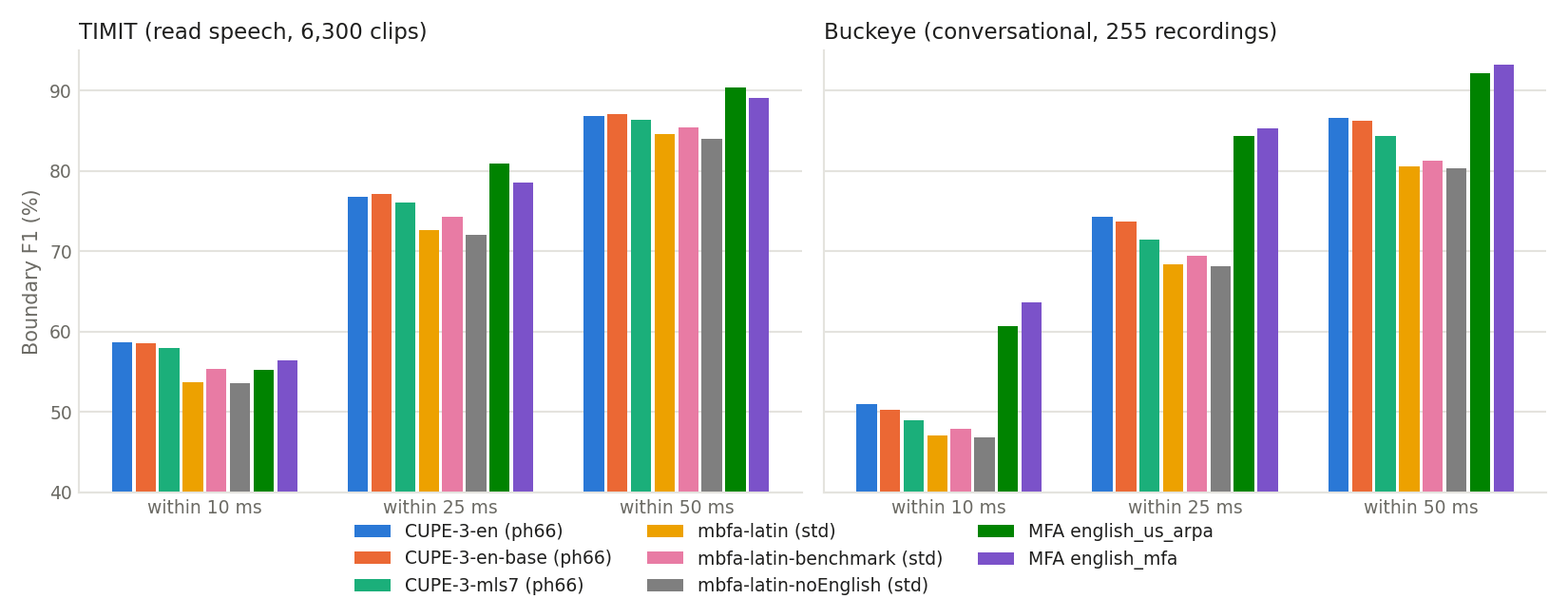
TIMIT
| method | phoneme set | F1 @10 | F1 @25 | F1 @50 | R @10 | R @25 | recall @25 | precision @25 | median error | predicted / labelled |
|---|---|---|---|---|---|---|---|---|---|---|
CUPE-3-en |
ph66 | 58.7 | 76.8 | 86.8 | 0.65 | 0.80 | 74.1 | 79.6 | 7 ms | 0.93 |
CUPE-3-en-base |
ph66 | 58.5 | 77.2 | 87.1 | 0.65 | 0.80 | 74.5 | 80.0 | 7 ms | 0.93 |
CUPE-3-mls7 |
ph66 | 58.0 | 76.0 | 86.4 | 0.65 | 0.79 | 73.4 | 78.8 | 7 ms | 0.93 |
mbfa-latin |
std | 53.7 | 72.6 | 84.6 | 0.61 | 0.77 | 72.2 | 73.0 | 8 ms | 0.99 |
mbfa-latin-benchmark |
std | 55.4 | 74.2 | 85.4 | 0.62 | 0.78 | 73.9 | 74.6 | 8 ms | 0.99 |
mbfa-latin-noEnglish |
std | 53.6 | 72.1 | 84.0 | 0.61 | 0.76 | 71.7 | 72.4 | 8 ms | 0.99 |
MFA english_us_arpa |
ARPAbet | 55.2 | 80.9 | 90.4 | 0.62 | 0.83 | 77.0 | 85.1 | 8 ms | 0.90 |
MFA english_mfa |
IPA | 56.5 | 78.6 | 89.1 | 0.63 | 0.81 | 73.8 | 84.0 | 8 ms | 0.88 |
Buckeye
| method | phoneme set | F1 @10 | F1 @25 | F1 @50 | R @10 | R @25 | recall @25 | precision @25 | median error | predicted / labelled |
|---|---|---|---|---|---|---|---|---|---|---|
CUPE-3-en |
ph66 | 51.0 | 74.2 | 86.6 | 0.56 | 0.76 | 78.7 | 70.3 | 9 ms | 1.12 |
CUPE-3-en-base |
ph66 | 50.2 | 73.7 | 86.3 | 0.55 | 0.76 | 78.1 | 69.8 | 9 ms | 1.12 |
CUPE-3-mls7 |
ph66 | 48.9 | 71.4 | 84.4 | 0.54 | 0.74 | 75.7 | 67.6 | 10 ms | 1.12 |
mbfa-latin |
std | 47.1 | 68.4 | 80.6 | 0.50 | 0.68 | 75.4 | 62.6 | 9 ms | 1.20 |
mbfa-latin-benchmark |
std | 47.9 | 69.4 | 81.3 | 0.50 | 0.69 | 76.5 | 63.5 | 9 ms | 1.20 |
mbfa-latin-noEnglish |
std | 46.9 | 68.1 | 80.4 | 0.49 | 0.68 | 75.1 | 62.3 | 9 ms | 1.20 |
MFA english_us_arpa |
ARPAbet | 60.6 | 84.3 | 92.1 | 0.65 | 0.86 | 87.3 | 81.5 | 8 ms | 1.07 |
MFA english_mfa |
IPA | 63.6 | 85.3 | 93.2 | 0.69 | 0.87 | 85.9 | 84.7 | 7 ms | 1.01 |
The columns: - R is the R-value. - Median error is taken over matched boundaries. - Predicted / labelled is the number of predicted onsets over the number of hand-labelled ones. Above 1 means the method placed boundaries the transcribers did not mark.
R-value ranks the methods as F1 does, with one difference. It penalises the extra onsets of the std models on Buckeye (1.20 predicted per labelled onset) a little harder than F1 does. R @25 there is 0.68-0.69, against 0.74-0.76 for the ph66 models.
How close is the nearest onset?
F1 is strict: each predicted onset may be matched to only one hand-labelled boundary, so an extra onset costs precision and a missing one costs recall. The figure below is the lenient view. For each hand-labelled boundary, it takes the distance to the nearest predicted onset, whether or not that onset is also the nearest one to another boundary.
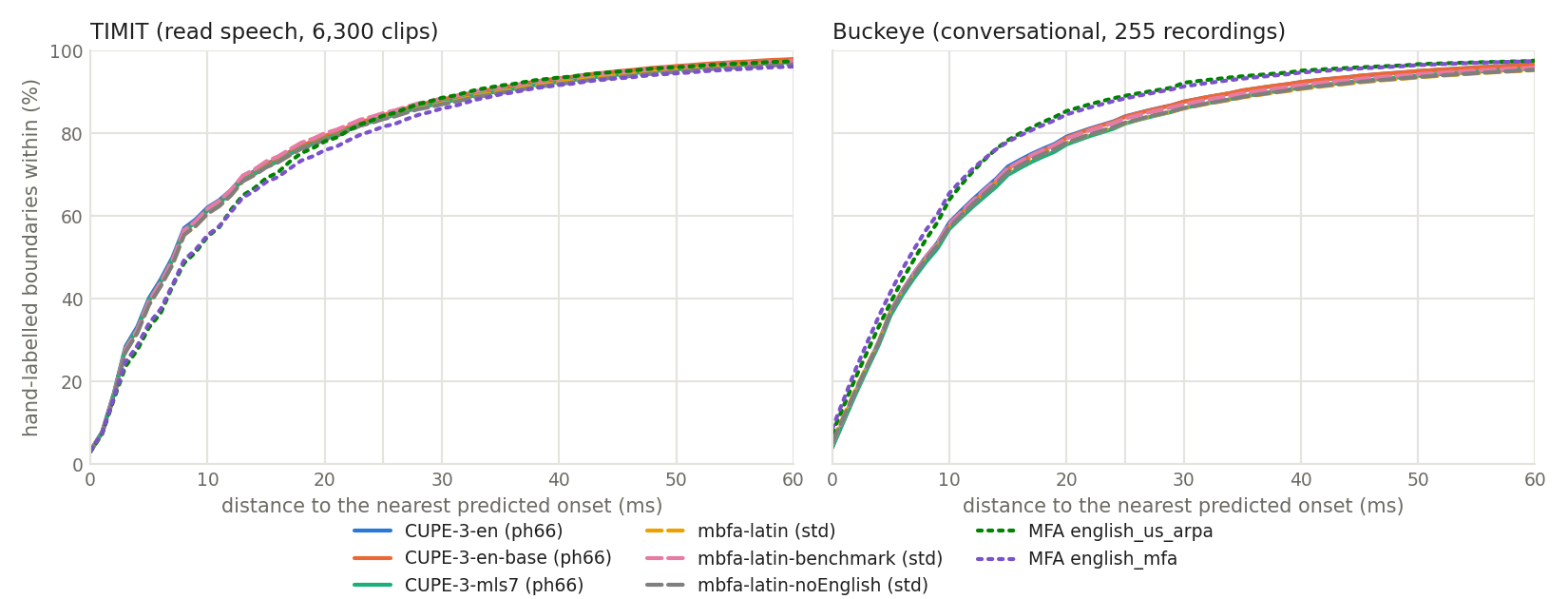
TIMIT:
- Up to 20 ms, all five BFA models are ahead of both MFA models. For example, CUPE-3-en has
a predicted onset within 10 ms of 62.1% of hand-labelled boundaries; the two MFA models have
55.0% and 55.4%.
- At 25 ms they are level with english_us_arpa.
- After that they stay within about a point of it.
Buckeye: MFA is ahead by 5-8 points between 10 and 30 ms.
Read with the tables, this means BFA places its onsets on read speech at least as well as MFA. Where it loses F1 is in how many onsets it places compared with how many were labelled.
Robustness to transcript errors
A forced aligner is only as good as its transcript, and real transcripts are wrong in places: ASR output, a dictionary or G2P pronunciation of reduced speech, a transcriber's typo. Forced alignment places every phone it is given. A phone that is not in the audio has to take time from its neighbours, and a phone missing from the text leaves its audio to them.
The test. The TIMIT transcripts were corrupted and the audio left untouched, so every condition is scored against the same hand labels. It is an accuracy test, not a consistency test. The 833 clips used are the first 1,000 of a seeded shuffle of TIMIT, keeping only clips whose every word both MFA dictionaries cover. They have 29,418 hand-labelled onsets. Two kinds of error were tested:
- Phone errors, at 5%, 10% or 20% of each clip's phones. Every N-th phone is:
- deleted;
- preceded by an inserted phone that was not spoken;
- replaced by a similar phone (/t/ → /d/);
- or replaced by one of the other major class (consonant ↔ vowel).
- Word errors, at 10% or 20% of the words. Every N-th word is deleted, preceded by an inserted word, or replaced by another word from the corpus vocabulary.
The error sites are the same for every system, and each system writes the replacement in its own phone set. BFA was given the corrupted phone sequence in place of its phonemizer's output, at its defaults. MFA was given a private dictionary of one entry per word, built from its own most likely pronunciation. Its clean condition uses the same kind of dictionary, so the only handicap, the loss of alternative pronunciations, is the same in every condition. It costs under a point: on clean transcripts of these clips, MFA scores 80.8 and 79.2 F1 @25 here, against 81.5 and 79.8 with its full dictionaries.
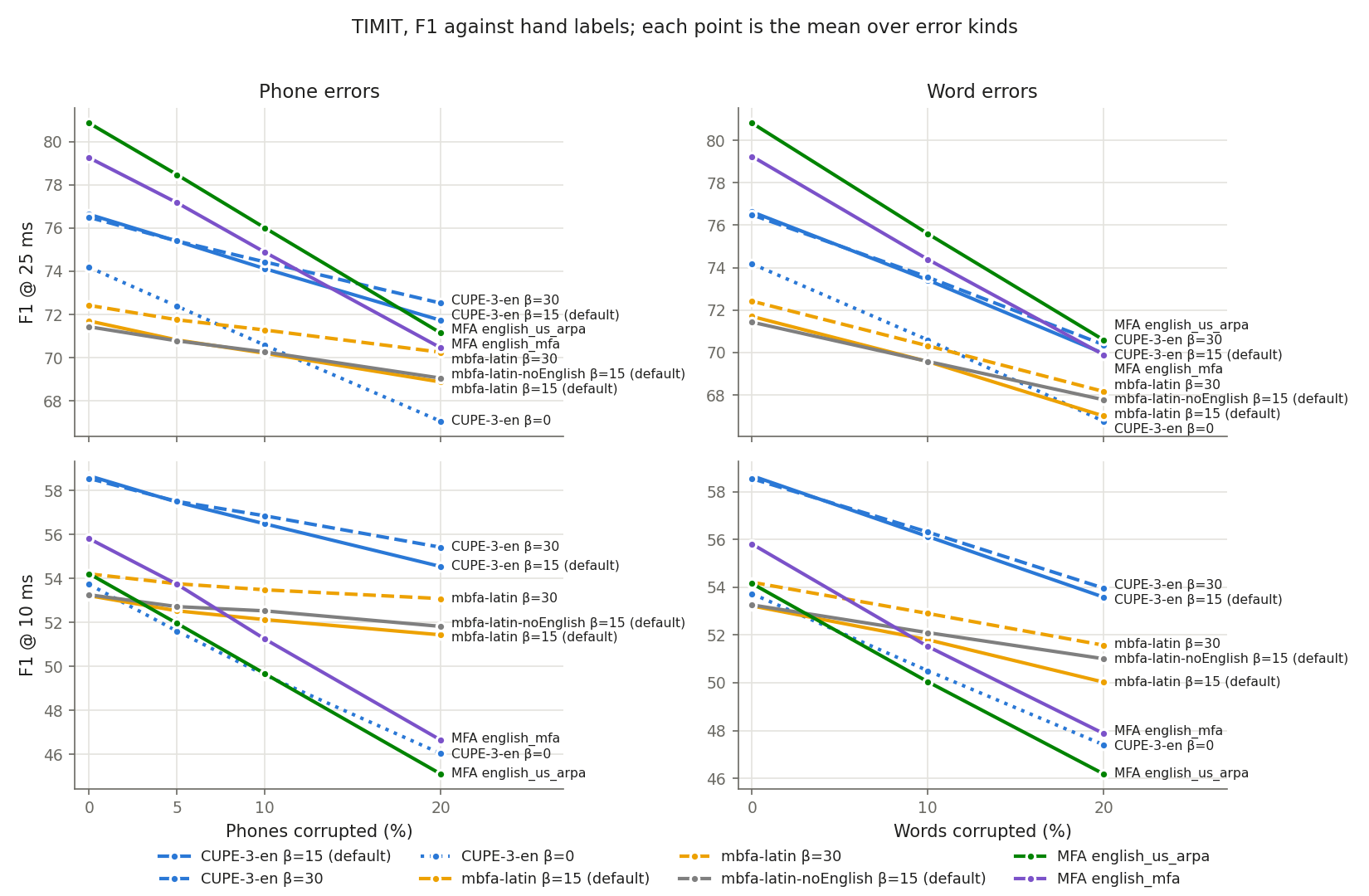
Each point is the mean over the error kinds at that rate; 0% is the clean transcript.
CUPE-3-en and mbfa-latin are also drawn at onset bonus 30, and CUPE-3-en at 0. Those
settings are discussed below.
F1 @25, with F1 @10 in brackets, averaged over the error kinds at each rate:
| method | clean | 5% phones | 10% phones | 20% phones | 10% words | 20% words | loss at 20% phones |
|---|---|---|---|---|---|---|---|
CUPE-3-en |
76.6 (58.7) | 75.4 (57.5) | 74.1 (56.5) | 71.7 (54.5) | 73.4 (56.1) | 70.0 (53.6) | −4.9 |
mbfa-latin |
71.7 (53.2) | 70.8 (52.5) | 70.2 (52.1) | 68.9 (51.4) | 69.6 (51.8) | 67.0 (50.0) | −2.8 |
mbfa-latin-noEnglish |
71.4 (53.3) | 70.8 (52.7) | 70.3 (52.5) | 69.1 (51.8) | 69.6 (52.1) | 67.8 (51.0) | −2.4 |
MFA english_us_arpa |
80.8 (54.2) | 78.5 (52.0) | 76.0 (49.7) | 71.1 (45.1) | 75.6 (50.0) | 70.6 (46.2) | −9.8 |
MFA english_mfa |
79.2 (55.8) | 77.2 (53.7) | 74.9 (51.2) | 70.5 (46.7) | 74.4 (51.5) | 69.9 (47.9) | −8.8 |
What it shows
- BFA loses about half as much as MFA per error.
- With 10% of the phones wrong, F1 @25 falls by 2.5 points for
CUPE-3-enand by 1.2-1.5 for the mbfa models, against 4.4-4.8 for MFA. - With 20% wrong, the falls are 4.9 and 2.4-2.8 for BFA, against 8.8-9.8 for MFA.
- Word errors give the same order: with 20% of the words wrong the falls are 6.7, 3.7-4.7 and 9.3-10.2.
- Every curve is close to a straight line in the error rate.
- MFA's clean lead does not survive errors.
- At 25 ms: with 20% of the phones wrong,
CUPE-3-enis ahead of both MFA models (71.7 against 71.1 and 70.5). With 20% of the words wrong it is level (70.0 against 70.6 and 69.9). - At 10 ms BFA leads at every rate, and the lead widens from 2.9-4.5 points on clean transcripts to 7.8-9.4 points with 20% of the phones wrong.
- The damage stays local.
- For phone errors, the harm to the phones that were left intact is concentrated in the corrupted phone and its immediate neighbours. From three phones away it is under 5 points, for every system and rate.
- An inserted word reaches about one word either side.
- What differs between the systems is how deep the damage goes, not how far it spreads.
After an other-class substitution at 10%, MFA misses 28-31 points more of the substituted
phone's own onsets, and 15-17 more of its neighbours'.
CUPE-3-enmisses 13.8 and 7.8. - The model that never heard English loses the least.
mbfa-latin-noEnglishloses the least of the three BFA models at every rate, and it is ahead ofmbfa-latinat 10 ms at every rate. The robustness comes from the method, not from English training data. - The onset bonus accounts for about half of BFA's advantage. Its evidence comes from the audio, not from the transcript.
- Without it (
boundary_bonus_weight=0),CUPE-3-enloses 1.4× as much as at the default of 15. - At 30 it loses slightly less than at 15: 0.4 points less with 10% of the phones wrong, 0.9 less with 20%.
- If your transcripts are known to be noisy (ASR output, for example), 30 is the safer setting. The default, 15, is set for conversational speech, where it scores higher than 30 for every model. On read speech the two are within about half a point.
- Low confidence partly flags a corrupted transcript. Take mean per-phone confidence over
a clip, with 10% of the phones corrupted. It separates corrupted clips from clean ones at
AUROC 0.66-0.70 for insertions and substitutions (
CUPE-3-en; 0.57-0.61 for the mbfa models). For deleted phones it does not separate them at all (0.50-0.52).
Languages: one model, no English needed
Neither corpus above has non-English boundary labels, so the scores here are all on English. Two results still speak to the other languages.
mbfa-latin-noEnglishis thembfa-latinrecipe trained on the same languages minus English. It aligns English, a language it has never heard, within 0.5 points F1 @25 ofmbfa-latinon TIMIT and 0.3 on Buckeye. Under transcript errors it loses less thanmbfa-latin(see above). English is only 7 h ofmbfa-latin's 273 h of training audio. A language's share of the training data matters little once the model covers its writing system and its sounds.CUPE-3-mls7isCUPE-3-en-baseafter one more epoch on seven European languages from MLS, with no English. It keeps all but 1.2 points of the English model's TIMIT F1 @25 (76.0 vs 77.2), and all but 2.3 on Buckeye.
Both point the same way: one model per writing system aligns a new language with no dictionary and no acoustic model of its own. See Language support for the languages each model was trained on, and its validation scores.
Cost
Every system was timed on one machine: - an AMD Threadripper PRO 5975WX pinned to 16 cores (32 threads); - one NVIDIA RTX A6000 for BFA's network, when a GPU was used; - BFA v2.0.1 and MFA 3.4.3.
BFA aligned all the clips in one process_segments call, in batches of 16, with 16 torch threads.
Its start-up is not included in the tables below: it is listed separately.
MFA ran mfa align with 8 jobs. Its time is the whole call, start-up included, and is given
for one flat folder and for one folder per speaker. Each figure is the median of three passes.
RTF (real-time factor) is processing time over audio duration: 0.01 means 100× faster than
real time.
100 TIMIT clips (5.2 min of audio, one sentence each)
| system | device | duration_max |
one call per clip | one call | one call, n_jobs 4 / 8 |
RTF |
|---|---|---|---|---|---|---|
BFA CUPE-3-en |
GPU | 10 s | 12.3 s | 2.1 s | 0.9 / 0.9 s | 0.003 |
BFA CUPE-3-en |
GPU | 30 s | 14.3 s | 3.6 s | 2.1 / 2.1 s | 0.007 |
BFA mbfa-latin |
GPU | 30 s | 23.0 s | 5.0 s | 3.3 / 3.3 s | 0.010 |
BFA CUPE-3-en |
CPU | 10 s | 28.9 s | 15.9 s | 15.4 / 16.2 s | 0.049 |
BFA CUPE-3-en |
CPU | 30 s | 57.9 s | 42.7 s | 39.8 / 40.4 s | 0.128 |
BFA mbfa-latin |
CPU | 30 s | 85.3 s | 54.7 s | 48.8 / 47.9 s | 0.154 |
MFA english_mfa (flat / per speaker) |
CPU | 95.2 / 112.1 s | 0.305 | |||
MFA english_us_arpa (flat / per speaker) |
CPU | 128.3 / 153.7 s | 0.412 |
10 Buckeye interviews (90.2 min of audio, 1,264 segments)
| system | device | duration_max |
one call per clip | one call | one call, n_jobs 4 / 8 |
RTF |
|---|---|---|---|---|---|---|
BFA CUPE-3-en |
GPU | 10 s | 45.9 s | 47.5 s | 12.9 / 10.7 s | 0.002 |
BFA CUPE-3-en |
GPU | 30 s | 60.1 s | 60.9 s | 25.7 / 25.1 s | 0.005 |
BFA mbfa-latin |
GPU | 30 s | 71.9 s | 69.7 s | 33.5 / 33.1 s | 0.006 |
BFA CUPE-3-en-base |
CPU | 30 s | 578 s | 590 s | 566 / 535 s | 0.099 |
BFA mbfa-latin |
CPU | 30 s | 648 s | 579 s | 562 / 555 s | 0.103 |
MFA english_mfa (flat / per speaker) |
CPU | 206.2 / 149.3 s | 0.028 | |||
MFA english_us_arpa (flat / per speaker) |
CPU | 243.0 / 185.9 s | 0.034 |
CUPE-3-en-base has the same network as CUPE-3-en and costs the same.
Start-up. A BFA process needs 3-9 s before its first clip, once: imports, loading the
model, and starting the n_jobs workers. The std models also load their G2P model with the
first clip (~4 s). MFA spends 59-100 s on start-up and setup in every call.
Start-up included, BFA against MFA:
| BFA with a GPU | BFA on a CPU | |
|---|---|---|
| 100 TIMIT clips | 8-21× sooner | 1.7-7.1× sooner |
| 10 Buckeye interviews | 3.6-15× sooner | 2.2-3.8× slower (30 s padding) |
one 32 s clip (30s.wav) |
1.3-1.5 s + start-up, against MFA's 79-120 s | 1.7-3.3 s + start-up |
What to choose
- Align many clips in one call.
process_segmentswith all your clips, orprocess_srt_filewith a whole transcript. On a GPU this is 4-6× faster than one call per short clip. - With a GPU, set
n_jobs=4. It runs the decoder in worker processes while the GPU works on the next batch: 2.4× faster on Buckeye at 30 s padding, 4.3× at 10 s. The output is identical. 8 workers help only atduration_max=10. - On a CPU, lower
duration_maxinstead. The network is almost all of the time, son_jobschanges little. Every segment is padded toduration_max, so 10 s instead of 30 s makes short clips 2.6× faster (TIMIT: 39.8 → 15.4 s) with identical onsets. Segments longer thanduration_maxare decoded whole, never cut. - The std models cost 1.0-1.6× the ph66 models at the same padding. Their G2P runs once per call over every new word.
- MFA is faster on a CPU for long conversational recordings at the default 30 s padding: each 2.2 s Buckeye segment is padded to 30 s. The effect of 10 s padding on Buckeye's scores was not measured.
Analysis
Read speech: BFA is more precise, MFA has fewer large misses
On TIMIT, BFA's errors are smaller when it is right (F1 @10 58.7 vs 55.2-56.5, median 7 vs 8 ms).
MFA pulls ahead from 25 ms on, because BFA's tail is heavier: its mean absolute error is
14.1 ms (CUPE-3-en) against MFA's 12.6-12.7 ms.
TIMIT also labels most stops as two intervals, a closure and a release (tcl t). Both
aligners place one onset per stop from the text, so one TIMIT boundary in ten (22,624 of
225,282 speech-phone onsets) is a release that neither can match one-to-one. This caps recall
for every method alike. The onset bonus pulls stop onsets towards the burst. That raises
boundary F1, but lowers accuracy when each phone's own onset is what you need: see
About the models.
Why Buckeye favours MFA
Buckeye's phone labels were not drawn from scratch. According to the corpus documentation, the labelling went in three steps:
- The audio and transcripts went first through the Entropic Aligner, an HMM forced aligner using phone models trained on TIMIT.
- Research assistants picked the best-fitting pronunciation from that aligner's dictionary of variants.
- They then corrected labels "placed at the wrong locations", using waveform and spectrogram displays.
A boundary the transcriber found acceptable kept the position the HMM aligner gave it.
That gives MFA three advantages on this corpus that have nothing to do with the audio:
- Same kind of aligner. MFA is a GMM-HMM aligner. Where Buckeye's boundaries are the original aligner's output, they follow HMM placement conventions that MFA reproduces.
- Same pronunciations. Buckeye's pronunciations were chosen from an ARPAbet variant dictionary, and MFA's dictionaries list variants too. BFA writes one pronunciation per word, with a G2P (std) or espeak-ng (ph66), so its phone sequences agree with the reference less often. This shows in two places:
- the predicted / labelled ratio: 1.01-1.07 for MFA, 1.12-1.20 for BFA;
- BFA's precision, 11-14 points lower.
- The benchmark it is developed against. MFA's own English benchmarks are Buckeye and TIMIT.
Our own numbers are consistent with this:
- Buckeye's audio is far harder than TIMIT's (conversational interview recordings). Every BFA
model scores 2.6-5.4 points lower on it than on TIMIT.
- Both MFA models score higher on Buckeye, by 3.4 and 6.7 points.
- MFA also gains most at the tightest tolerance (F1 @10 +5.4 and +7.1). That is what
reproducing the reference's own placement looks like.
- The phone set is not the reason: the IPA english_mfa gains more than the ARPAbet model.
TIMIT was segmented by hand, and it is the better test of where an aligner puts boundaries.
Two further things hold BFA back on Buckeye, and both can be changed:
- Reduced speech. Conversational English drops and merges phones ("probably" → "prolly"). Forced alignment places every phone of the text, so a phone the speaker skipped becomes an extra onset squeezed between real ones. This is the same kind of transcript error as above. A phonemizer that wrote reduced pronunciations would close part of the gap. A better acoustic model would not.
- The onset bonus. On the full corpus, turning the bonus off (
boundary_bonus_weight=0) raises the CUPE-3 models' Buckeye F1 @25 by 1.6-3.2 points over their default of 15 (CUPE-3-en: 76.4 against 74.2). The cost is 2.0-3.7 points on TIMIT, and more under transcript errors. On Buckeye the std models move by under 1 point either way (mbfa-latin-benchmark: 70.0 without the bonus, 69.4 at its default of 15).
coverage_analysis["bad_alignment"] flags the worst segments. It flags under 1% of Buckeye
segments for the two English CUPE-3 models, and 4-8% for CUPE-3-mls7 and the mbfa models.
Why the std models score lower
The std models are multilingual (36 trained languages for mbfa-latin). They score 4.2-5.8
points below the English-only CUPE-3 models. Two separate things are in that gap:
- Diphthongs and affricates are two tokens in std. The std phoneme set writes /aɪ/ as
a ɪand /tʃ/ ast ʃ, so the std models place an onset inside every diphthong and affricate. ph66 has one token for each, as the corpora do. - These extra onsets are the difference between std's predicted / labelled ratio and ph66's: 0.99 vs 0.93 on TIMIT, and 1.20 vs 1.12 on Buckeye.
- The scorer can merge them (
merge_two_token_phones: trueinevaluate.yaml), but that barely moves F1: TIMIT 72.6 → 72.5, Buckeye 68.4 → 68.1 formbfa-latin. TIMIT itself splits stops and affricates, and the second token often lands on the release. - These tables leave the merge off, so every method is scored on the onsets it actually emits.
- Training data and noise.
CUPE-3-enheard 500 h of English.mbfa-latinheard 273 h across 36 languages, of which English is a small share, and was trained with more added noise (for robustness on real recordings). mbfa-latin-benchmark, trained with less noise, is 1.0-1.6 points ahead on the two corpora.mbfa-latin-noEnglish, trained with no English at all, is only 0.3-0.5 points behindmbfa-latin. English data are therefore a small part of the gap.
For English alone, use the ph66 set (BFA(preset="en-us", phoneme_set="ph66")). For anything
else, or for tone, stress and length labels, use std.
Per phone class
Mean absolute error (ms) of matched onsets, by manner class. These columns are filled the same way
for every method (mn_* in the CSVs).
| vowels | voiceless stops | voiced stops | voiceless fricatives | voiced fricatives | nasals | laterals | rhotics | glides | |
|---|---|---|---|---|---|---|---|---|---|
TIMIT CUPE-3-en |
12.9 | 11.8 | 17.1 | 11.5 | 15.0 | 14.1 | 20.6 | 17.7 | 21.0 |
TIMIT mbfa-latin |
16.6 | 12.7 | 15.9 | 12.9 | 16.6 | 14.2 | 19.5 | 19.3 | 17.4 |
TIMIT MFA english_us_arpa |
11.3 | 11.1 | 14.6 | 13.4 | 12.7 | 10.8 | 17.6 | 18.7 | 16.7 |
Buckeye CUPE-3-en |
15.5 | 15.3 | 12.9 | 12.5 | 14.0 | 13.5 | 22.2 | 22.2 | 17.8 |
Buckeye mbfa-latin |
16.5 | 17.4 | 15.1 | 14.6 | 15.1 | 14.7 | 19.7 | 22.5 | 17.0 |
Buckeye MFA english_us_arpa |
10.6 | 11.2 | 11.9 | 11.4 | 10.8 | 10.6 | 16.7 | 16.6 | 14.3 |
The hardest boundaries are the same for everyone: laterals, rhotics and glides, whose onsets are gradual transitions with no acoustic edge.
On TIMIT, CUPE-3-en:
- beats MFA on voiceless fricatives and rhotics;
- is within a millisecond of it on voiceless stops;
- has its largest deficits on nasals, voiced stops and voiced fricatives (2-3 ms each).
Confidence
Mean per-phone confidence over each corpus (the model's peak posterior inside each phone's segment):
CUPE-3-en |
CUPE-3-en-base |
CUPE-3-mls7 |
mbfa-latin |
mbfa-latin-benchmark |
|
|---|---|---|---|---|---|
| TIMIT | 0.54 | 0.40 | 0.26 | 0.25 | 0.17 |
| Buckeye | 0.43 | 0.32 | 0.21 | 0.20 | 0.16 |
The models are trained towards a target with deliberate entropy, so these numbers are far below 1.0 even where the alignment is right. Each model also has its own scale, so compare confidences within one model, never across models.
As a per-phone error detector, confidence is weak. Call a predicted onset bad when it is unmatched or more than 50 ms off. Low confidence then picks out bad onsets at AUROC 0.56-0.63, and the 10% of onsets with the lowest confidence are bad 1.3-2.2× as often as the rest. It is more useful at the level of a whole clip, as a flag for a wrong transcript (see above) or a failed segment. See About the models.
Per-run error histograms
Distance from each hand-labelled boundary to the nearest predicted onset (0-100 ms), one plot
per run. These are written by compute_metrics.py.
TIMIT (7 plots)
| | | |---|---| |  |  | |  |  | |  |  | |  | |Buckeye (7 plots)
| | | |---|---| |  |  | |  |  | |  |  | |  | |What is not measured here
- Boundary accuracy in languages other than English. Neither corpus has non-English boundary
labels. The eight non-Latin models (cyrillic, cjk, japanese, vietnamese, thai, abjad, brahmic,
other_alphabetic) were selected on validation loss over their own alignments, and have no
boundary score.
CUPE-3-mls7is scored here on English only: the score shows how much English accuracy survived its multilingual epoch, not how well it aligns German or French. A hand-labelled non-English corpus would close this gap. - Real ASR transcripts. The transcript-error test uses controlled, synthetic errors.
- Sub-frame onsets, the library default. These runs use the 5 ms frame grid.
Reproducing
python evaluation/dataset/timit_parser.py       # ground truth, once
python evaluation/dataset/buckeye_parser.py
python evaluation/process_alignments.py         # align (the experiments in evaluate.yaml)
python evaluation/compute_metrics.py            # score into evaluation/results/results_<dataset>.csv
python evaluation/plot_summary.py               # the two comparison figures above
The transcript-error test and the timing benchmark are not part of this harness yet.
See evaluation methods for the configuration, run naming, caching and parallel runs.